We are heart-broken to say that this year’s Truth be Told Festival had to be postponed due to the pandemic. This was a very hard decision to make, as we were very excited about sharing this year’s films with all of you. The choice, however, was obvious. Instead of going ahead with an online version of the festival, we have decided to wait until it’s safe to have an on-site screening. This was an unprecedented and difficult academic year and our students deserve praise for their perseverance, heartfelt commitment and care. We greatly look forward to welcoming you all back, sharing these films with you, and celebrating their achievements together. Further announcements will be posted here and on our blog / social media. In the meantime, we invite you to take a look at the 2020 Teaser – a sneak preview of student films completed in the program this year.
All the best,
Amir Husak (Director, Graduate Certificate in Documentary Studies) & Doc Studies production team
The last two months have been an incredibly probing time for all of us. A true emotional rollercoaster! As the pandemic forced us to adapt in ways we never imagined, we found ourselves embracing a whole range of creative alternatives and discovering different forms of solidarity and fortitude. The Doc Studies Class of 2020 persevered and successfully completed the program (and their films!) in an awe-inspiring display of commitment, care, and resilience. Their journey to graduation – especially considering the present circumstances – is an accomplishment that ought to be celebrated. Hereby, we want to invite you to join us in congratulating them. Also, please join us at the School of Media Studies Recognition Ceremony, presented tomorrow at 3pm EST via Livestream or on Facebook. #docstudies2020#newschoolgrad
Monday, Mar. 9th at 1PM Kellen Auditorium, 66 Fifth Ave
Poetic and urgent, eye-opening and razor-sharp, THE CANCER JOURNALS, REVISITED is the cinematic embodiment of Lorde’s deep belief in collective power.
Christina Ree, San Diego Asian Film Festival
Utilizing a non-narrative, poetic approach to the documentary form, the filmmaker channels a plurality of lived, felt experiences into a collective act of better world building.
Amber Power, BOMB Magazine
Join us for this special screening of filmmaker and Media Studies faculty Lana Lin’s award winning documentary, The Cancer Journals Revisited. The film is a poetic rumination on the precarious conditions of survival for women of color today. 27 artists, activists, health care advocates, and current and former patients recite Black lesbian feminist poet Audre Lorde’s classic 1980 memoir of her breast cancer experience aloud on camera, collectively dramatizing it and producing an oration for the screen. The Cancer Journals Revisited reflects upon what it means to contend with the complex dimensions of illness and its afterlife.
Lana Lin is an artist, filmmaker and writer based in New York. Her work has been shown at international venues including the Whitney Museum and Museum of Modern Art, NY; Stedelijk Museum, Amsterdam; Wexner Center for the Arts, Columbus, OH; Oberhausen Film Festival, Germany; Taiwan International Documentary Film Festival; Gasworks, London; China-Taipei Film Archive; and the 2018 Busan Biennale. She has received awards from the New York State Council on the Arts, New York Foundation for the Arts, and the Jerome Foundation, and has been a fellow at the MacDowell Colony, Civitella Ranieri, and the Vera List Center for Art and Politics. A recent acquisition of Women Make Movies, her latest film, The Cancer Journals Revisited, premiered at BAMcinemaFest and won Best Documentary Feature, San Diego Asian Film Festival and Favorite Experimental Film Award, BlackStar Film Festival. The author of Freud’s Jaw and Other Lost Objects: Fractured Subjectivity in the Face of Cancer (Fordham UP, 2017), Lin is currently an India China Institute and GIDEST fellow, and Associate Professor in the School of Media Studies at The New School.
Please join us for this screening and Q&A, hosted and moderated by Amir Husak, Director of Documentary Studies and Assistant Professor in the School of Media Studies.
“The film that took the top of my head off was Speak So I Can See You….It’s on another planet from character-driven narrative, in a good way…. Art museums should embrace it. Radio aficionados will fall in love with it, and historians will treasure it.” – Pat Auderheide, IDA journal
“Rich in…brilliant moments…. immersing the viewer in quite a unique cinematic experience. And, commendably, it also leaves some room for irony.” – David Abbatesciani, Cineuropa
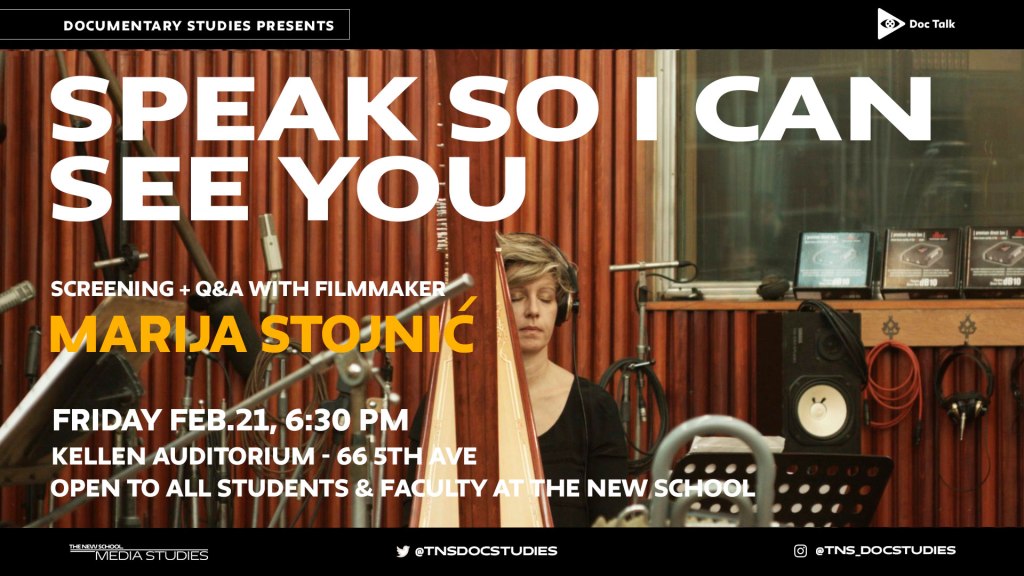
Serbian filmmaker and Media Studies alumna Marija Stojnić will screen Speak So I Can See You, her new documentary feature on Friday, February 21st at 6:30pm in Kellen Auditorium. The film premiered at International Documenary Film Festival in Amesterdam last fall, and it is featured at MoMA’s DocFortnight this month. Stojnić, who brings her background in music and keen understanding of the art of documentary, has crafted an original work—a “cinematic soundscape” that captures the wonders of Radio Belgrade, Serbia’s long-lived radio station, which has kept history, culture and critical thinking alive in the former Yugoslavia. Borrowing upon the cumulative effect of slow tracking shots and close-ups of cryptic technological grids and patient performers testing microphones, Stojnić portrays the station in the throes of change as it abandons the dilapidated equipment of its Tito-era studios for the bright newness of the now while clinging to all it holds dear. Her observational visuals illuminate the sounds of the radio past and present, including moments from beloved shows like “The Invisible People” and “Journey through Words,” jazz tributes on “Needle on Vinyl” and live performances of opera, and dramatic readings of writers like Dostoyevsky and Carl Sagan. Stojnić’s underlying focus is on the people who keep Radio Belgrade going—audio engineers, actors, announcers, directors, moving men, and cleaning ladies—while inviting viewers into the haunting space, time, and sounds of Radio Belgrade. Even if you never lived through ’68 or wondered about the future of the former USSR or listened through the night and in your dreams to the rambling thoughts of Radio Belgrade’s philosophical radio hosts, Stojnić’s film conjures a collective memory of the past through audio echoes personal and public.
The film is a love letter to radiophonic art, subtly and playfully demonstrating how radio can make us remember, understand, think, and feel.
Stojnić will join Media Studies faculty member Deirdre Boyle for a Q&A after the screening. This program is open to all students and faculty of The New School.
“Outstanding… An information revolutionary, Stokes, despite her decades of isolation, touched the nerve center of the times.” – Best Films of 2019, New Yorker
“Weirdly exhilarating… Enlightening and the stuff of madness.” Critic’s Pick – New York Times
“The Information Age has found a startling, eccentric heroine in the subject of Matt Wolf’s eye-opening documentary.” – LA Times
Marion Stokes was secretly recording television twenty-four hours a day for thirty years. It started in 1979 with the Iranian Hostage Crisis at the dawn of the twenty-four hour news cycle. It ended on December 14, 2012 while the Sandy Hook massacre played on television as Marion passed away. In between, Marion recorded on 70,000 VHS tapes, capturing revolutions, lies, wars, triumphs, catastrophes, bloopers, talk shows, and commercials that tell us who we were, and show how television shaped the world of today.
Before “fake news” Marion was fighting to protect the truth by archiving everything that was said and shown on television. The public didn’t know it, but the networks were disposing their archives for decades into the trashcan of history. Remarkably Marion saved it, and now the Internet Archive will digitize her tapes and we’ll be able to search them online for free.
This is a mystery in the form of a time capsule. It’s about a radical activist, who became a fabulously wealthy recluse archivist. Her work was crazy but it was also genius, and she would pay a profound price for dedicating her life to this visionary and maddening project.
Matt Wolf is an award-winning filmmaker in New York whose feature documentaries include Wild Combination, about the cult cellist and disco producer Arthur Russell and Teenage, about early youth culture and the birth of teenagers. His new film Spaceship Earth about the controversial Biosphere 2 experiment is premiering at Sundance 2020. Matt’s short films include I Remember, about the artist and poet Joe Brainard, Time Magazine’s The Face of AIDS about a controversial Benetton advertisement, and Bayard & Me, about the civil rights activist Bayard Rustin. He is also the director of HBO’s It’s Me, Hilary and is the co-curator of film for the 2019 Whitney Biennial. He is a Guggenheim Fellow.
Please join us for this screening and Q&A, hosted and moderated by Amir Husak, Director of Documentary Studies and Assistant Professor in the School of Media Studies.
The Hottest August (95 min) Monday, January 27, 2020 @ 1:00 PM EST
Kellen Auditorium 66 Fifth Avenue New York, NY 10011
A complex portrait of a city and its inhabitants, The Hottest August gives us a window into the collective consciousness of the present. The film’s point of departure is one city over one month: New York City, including its outer boroughs, during August 2017. It’s a month heavy with the tension of a new President, growing anxiety over everything from rising rents to marching white nationalists, and unrelenting news of either wildfires or hurricanes on every coast. The film pivots on the question of futurity: what does the future look like from where we are standing?
And what if we are not all standing in the same place? The Hottest August offers a mirror onto a society on the verge of catastrophe, registering the anxieties, distractions, and survival strategies that preoccupy ordinary lives.
Brett Story is an award-winning filmmaker whose work has screened at festivals internationally, including the Viennale, True/False, and Oberhausen. Her 2016 feature documentary, The Prison in Twelve Landscapes, was awarded the Special Jury Prize at the Hot Docs Canadian International Documentary Festival and was a nominee for Best Feature Documentary at the Canadian Screen Awards. Brett holds a PhD in geography from the University of Toronto and is currently an assistant professor in the School of Image Arts at Ryerson University. She is the author of the book, Prison Land, and co-editor of the forthcoming volume, Infrastructures of Citizenship. Brett was a 2016 Sundance Institute Art of Nonfiction Fellow and a 2018 Guggenheim Fellow in film and video.
Please join us for this screening and Q&A, hosted and moderated by Amir Husak, Director of Documentary Studies and Assistant Professor in the School of Media Studies.


 The New School Doc Studies